4 September 2026 · Daivagya
When Will I Get Married? A Complete Guide to Predicting Marriage Age From Your Birth Chart
Learn how Vedic astrology reveals your marriage age through the 7th house, Vimshottari Dasha, Navamsa, and planetary transits in your birth chart.
Quick answer
Vedic astrology determines marriage age by analyzing the strength of the 7th house and its lord, natural marriage karakas like Jupiter and Venus, active Vimshottari Dasha periods, and the triggering transits of Saturn and Jupiter. Rather than a single fixed date, a birth chart reveals high-probability astrological windows when circumstances align for marriage.
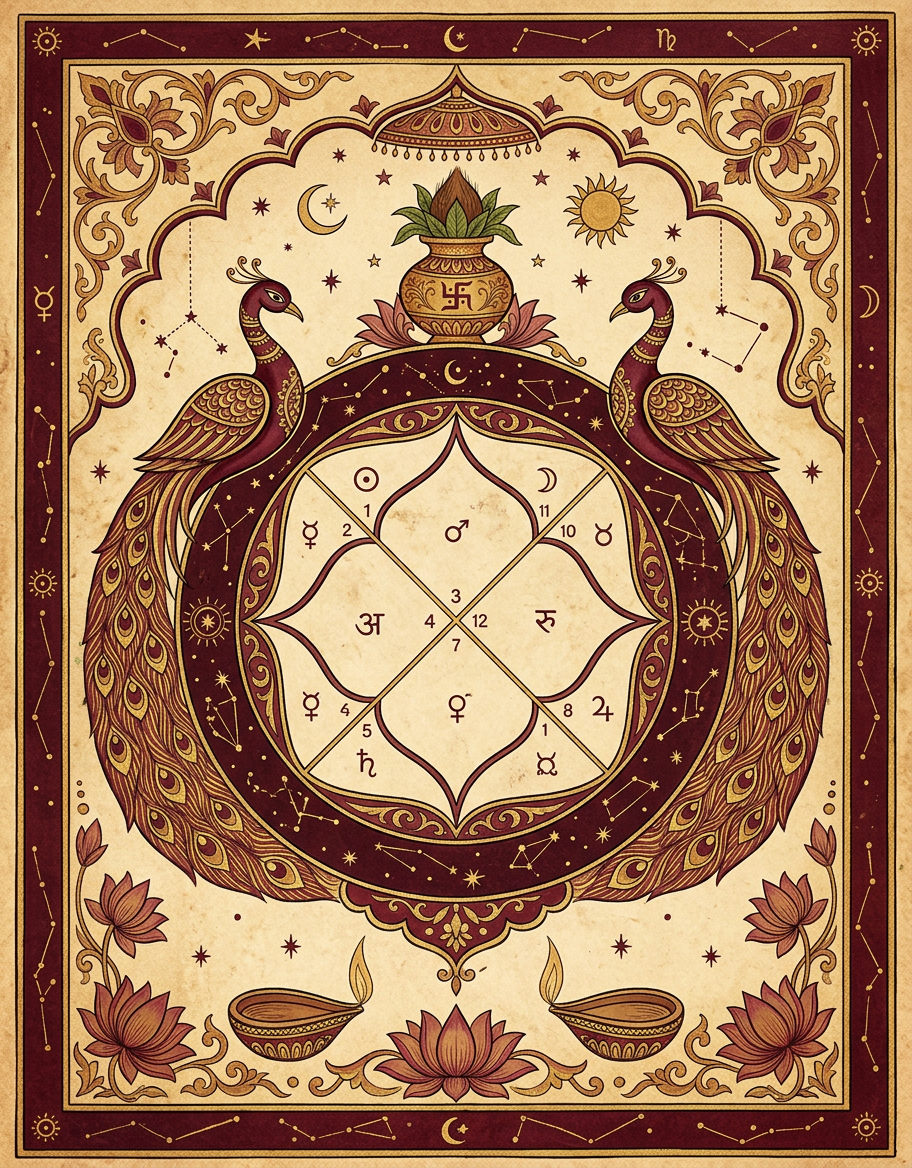
In my consultation room in Noida, few questions carry as much genuine emotion, hope, and vulnerability as "When will I get married?" Whether asked by a young professional in their mid-twenties planning ahead, or a person in their thirties wondering why opportunities keep slipping away, the desire for clarity around marriage timing is deeply universal.
In Vedic astrology, marriage is not viewed as a random event or mere coincidence. It is considered a significant karmic milestone (Samskara) governed by clear cosmic patterns. Your birth chart (Janam Kundli) acts as a detailed blueprint of your life's unfolding karma. By reading the alignment of the houses, the planetary periods you are running, and the active movements of slow-moving planets, an experienced astrologer can decode your marriage age prediction with remarkable precision.
In this comprehensive guide, I will take you step-by-step through the exact classical methods we use to determine when marriage is most likely to happen in your life.
Why is marriage age one of the most common questions in Vedic astrology?
Marriage is one of the most life-altering transitions a person ever experiences. It changes your daily routine, your financial trajectory, your emotional well-being, and your family structure. Because of the profound nature of this union, ancient Vedic seers dedicated immense study to understanding its timing.
When people ask when will I get married, they are rarely just looking for a calendar date. They are looking for peace of mind, reassurance during periods of uncertainty, and practical clarity so they can align their personal and professional lives.
Astrology does not replace human free will, nor does it promote fatalism. Instead, it reveals the ripening of karma (Prarabdha Karma). Just as a farmer waits for the right season to plant and harvest crops, knowing your marital timing helps you recognize when the universe is creating supportive conditions for partnership.
Which houses and planets govern your marriage timing?
Before we look at specific ages or time windows, we must understand the fundamental architecture of the birth chart regarding relationships. Several specific houses and planets hold the keys to predicting marriage age from birth chart analysis.
- The 7th House: This is the primary house of marriage, legal unions, and lifelong partnerships. The sign on the 7th house cusp and any planets seated inside it set the baseline tone for your marital journey.
- The 7th Lord: The planetary ruler of the sign occupying your 7th house. Its strength, placement in supportive or difficult houses, and associations indicate the ease or complexity of getting married.
- The 2nd House: The house of family expansion (Kutumba Bhava). Marriage brings an addition to your family circle, making the 2nd house vital for timing ceremonies and household union.
- The 11th House: The house of fulfilled desires, social agreements, and long-term gains (Labha Bhava). It confirms whether romantic intentions materialize into formal commitments.
- The 1st House (Lagna): Your physical self and vitality. A marriage cannot manifest unless the Lagna and Lagna lord are receptive to receiving a partnership.
Beyond the houses, two natural signifiers (Karakas) are universally examined:
- Venus (Shukra): The natural significator of romance, attraction, marital harmony, and partner energy. In a male chart, Venus specifically represents the wife.
- Jupiter (Guru): The planet of divine grace, auspicious ceremonies, wisdom, and family blessing. In a female chart, Jupiter traditionally signifies the husband and marital stability.
If you do not yet know your planetary placements, you can generate your natal chart using our free kundli tool to follow along with the concepts explained below.
How does the Vimshottari Dasha system reveal your marriage age?
In Parashari Vedic astrology, the birth chart outlines your potential, but the Vimshottari Dasha system decides the timing. You may have the most auspicious 7th house in the world, but marriage will only manifest when you enter a planetary period (Mahadasha, Antardasha, or Pratyantardasha) that holds the authority to deliver marriage.
During an astrological reading, I look for active Dasha periods of specific planetary rulers:
- The Dasha of the 7th Lord: When you run the major or minor period of the planet owning your 7th house, marital proposals and relationship discussions naturally come to the forefront.
- The Dasha of Planets Placed in the 7th House: Any planet residing in your 7th house absorbs the agenda of marriage and actively works to bring a partner during its operative period.
- The Dasha of the Lagna Lord or 2nd Lord: These periods frequently tie the knot because the 1st lord represents you stepping into a new life stage, while the 2nd lord brings family growth.
- The Dasha of Natural Karakas (Venus or Jupiter): If well-placed, running a Venus or Jupiter sub-period between the ages of 21 and 35 strongly activates marriage opportunities.
- The Dasha of Dispositors: The planet hosting the 7th lord in its sign (its dispositor) can also act as an agent of marriage during its sub-period.
When two or three of these indicators align within a specific Antardasha (sub-period), that 12 to 24-month window becomes your primary marriage timeframe.
What role do planetary transits (Gochara) play in triggering marriage?
If the Dasha system sets the seasonal window, planetary transits for marriage act as the exact trigger that opens the door. A Dasha indicates that the promise is ripe; the transits (Gochara) confirm that the physical environment is ready for the wedding ceremony.
In classical astrology, we rely heavily on the Double Transit Method involving Saturn (Shani) and Jupiter (Guru):
- Jupiter's Transit: As the planet of blessings and expansion, transiting Jupiter must aspect or transit over your natal 7th house, the 7th lord, the 1st house, or the natal position of Venus/Jupiter. Jupiter's aspect grants divine sanction and societal approval.
- Saturn's Transit: While Saturn is often misunderstood as merely a delay-causing planet, it is also the grand executor of destiny. Saturn must give its nod by transiting or aspecting the 7th house, the 7th lord, the Lagna, or the Lagna lord. Saturn solidifies the karmic duty and legal responsibility of marriage.
When both Jupiter and Saturn simultaneously influence your 7th house or its lord through transit—while you are running a favorable Dasha—marriage almost invariably takes place within that 12-month period.
How do astrologers calculate early, timely, and delayed marriage windows?
Every birth chart holds a unique energetic signature that leans toward an early, timely, or mature marriage age. In classical texts, these windows were defined relative to societal norms, but in modern consultations, we adapt these planetary principles to contemporary life stages.
Here is a reference guide showing how planetary combinations correlate with marriage age brackets:
| Marriage Window | Typical Age Bracket | Key Astrological Indicators in the Birth Chart |
|---|---|---|
| Early Marriage | 21 to 24 years | Benefic planets (Venus, Jupiter, Mercury, Moon) in the 7th house; 7th lord placed in the 1st, 2nd, or 11th house without malefic aspect; strong Lagna and Venus; early Dasha of 7th lord or Venus. |
| Timely / Normal Marriage | 25 to 29 years | 7th lord well-placed in Kendra (1st, 4th, 7th, 10th) or Trikona (5th, 9th) houses; mild or balanced malefic influence; supportive Jupiter transit occurring in mid-twenties during a supportive Antardasha. |
| Mature / Settled Marriage | 30 to 34 years | Saturn influencing the 7th house or 7th lord via conjunction or aspect; Sun or Mars in the 7th house causing career prioritization; 7th lord in the 6th, 8th, or 12th house receiving benefic aspects later in life. |
| Delayed Marriage | 35 years and beyond | Retrograde Saturn strongly afflicting both 7th house and Venus; Rahu-Ketu axis directly across the 1st/7th house with weak dispositors; combustion of the 7th lord; unsupportive Dashas running throughout the twenties and early thirties. |
It is essential to understand that a "delayed" marriage is not an inferior marriage. In my years of practice, I have frequently seen charts where a later marriage after age 30 proved vastly more stable, prosperous, and emotionally fulfilling than an earlier union would have been.
Why must you look at the Navamsa (D9) chart before finalizing a marriage age?
Looking only at the basic Rashi chart (D1) to predict marriage age is one of the most common mistakes amateur practitioners make. In Vedic astrology, the Rashi chart shows the external tree of your life, but the Navamsa Chart (D9) reveals the fruit.
The D9 chart is the foundational divisional chart for all matters concerning marriage, inner potential, and the second half of life. Here is how we use the Navamsa to verify marital age:
- Navamsa Lagna and 7th House: If the birth chart suggests an early marriage window, but the Navamsa 7th house contains severe afflictions or a debilitated 7th lord, the marriage will likely face obstacles until maturity is reached.
- Vargottama Planets: When the 7th lord or Venus occupies the same zodiac sign in both the D1 and D9 charts, it is termed Vargottama. This gives tremendous strength and ensures that marriage manifests smoothly during its designated Dasha window.
- Pushkara Navamsa: If your 7th lord falls within a Pushkara Navamsa (highly auspicious degrees that nourish and heal), it often accelerates marriage proposals and brings a deeply supportive partner, even if there are minor delays in the main chart.
Without cross-referencing the D9 chart, an astrologer's prediction of marriage timing remains incomplete.
How do Jaimini astrology techniques refine the marriage timing?
While the Parashari method using Vimshottari Dasha and planetary lords is the most common approach, advanced practitioners frequently integrate Jaimini Astrology to achieve pinpoint accuracy.
Jaimini astrology relies on planetary degrees rather than house ownership to identify specific relationship markers:
- Darakaraka (DK): The planet holding the lowest degree in your birth chart (excluding Rahu and Ketu) becomes your Darakaraka—the soul indicator of your spouse. The Chara Dasha (sign-based period) of the sign holding your Darakaraka or the sign aspecting it frequently brings your life partner.
- Upapada Lagna (UL): Calculated from the 12th house, the Upapada Lagna signifies formal marriage and societal bonding. When you enter the Chara Dasha of the sign containing your UL or its 7th house, wedding bells are almost guaranteed.
When both the Parashari Vimshottari Dasha and the Jaimini Chara Dasha point to the exact same two-year window, you can be exceptionally confident that significant marital events will unfold.
What planetary factors cause marriage to shift beyond expected ages?
Sometimes, despite sincere efforts, marriage does not occur during what society considers the "standard" age bracket. When I analyze such horoscopes, specific planetary configurations explain why the timing has shifted:
- The Influence of Saturn (Shani): Saturn represents maturity, patience, and realistic expectations. When Saturn aspects the 7th house, it demands that the native first develop emotional maturity, career stability, or personal independence before entering marriage.
- The Rahu-Ketu Axis: If Rahu or Ketu sits in the 7th house, relationship dynamics often follow non-linear paths. Rahu can create intense early infatuations that dissolve, delaying formal marriage until the native learns what they genuinely need.
- Combustion or Retrogradation: A combust 7th lord (sitting too close to the Sun) or a retrograde 7th lord can create hesitations, repeated negotiations that stall, or sudden changes in mind right before alliances are finalized.
- Unfavorable Running Dashas: If an individual spends their twenties running the Mahadasha of the 6th lord (disputes/litigation), 8th lord (sudden changes), or 12th lord (isolation/distance), marriage discussions may repeatedly face logistical or personal hurdles.
Understanding these factors removes guilt and self-blame. It helps you recognize that your timeline is governed by cosmic growth cycles rather than personal failure.
Practical steps and remedies if you are waiting for marriage
If your birth chart indicates an approaching marriage window, or if you are currently navigating a period of delay, here is how you can constructively approach your journey:
- Verify Your Exact Birth Details: Marriage timing techniques depend heavily on the accuracy of your ascendant and Navamsa chart. Even a five-minute error in your recorded birth time can shift your Navamsa Lagna and alter timing calculations by a year or more.
- Strengthen Your Benefic Planets: Rather than fearing afflictions, focus on strengthening your chart's natural benefics. Nurturing your Jupiter through selfless acts, supporting teachers, and maintaining ethical conduct enhances family blessings.
- Engage in Traditional Propitiations: Simple Vedic remedies such as chanting the Swayamvara Parvathi Mantra, observing fasting on Thursdays (for Jupiter) or Fridays (for Venus) where suitable, and performing planetary pacification (Grah Shanti) help remove subtle karmic obstructions.
- Align Effort with Astrological Seasons: When your chart enters an active marriage Dasha, increase your social engagement, accept family introductions, and keep an open, flexible mindset. Astrology highlights the open door, but you must still choose to walk through it.
If you would like a personalized, in-depth evaluation of your birth chart, Navamsa, and upcoming Dasha periods, you are welcome to book a consultation for a comprehensive one-on-one session.
Frequently asked questions
Can an astrologer predict the exact month or day of marriage?
Astrology operates primarily through probability windows rather than rigid calendar minutes. An experienced astrologer can accurately identify a 12 to 18-month Dasha window and narrow it down to a 2 to 3-month transit phase. The exact day is ultimately finalized through Muhurat—the conscious election of an auspicious date within that supportive cosmic window.
Does having Saturn in the 7th house always mean marriage after 30?
Not always, but it strongly favors maturity. Saturn in the 7th house tests relationships to ensure long-term stability. If Saturn is in its own sign (Capricorn or Aquarius) or exalted (Libra), it can grant a highly disciplined, lasting marriage earlier if running Dashas are exceptionally favorable. However, a settled marriage between 28 and 33 is most common.
What is the double transit method for marriage timing?
The double transit method is a classical timing technique where both Jupiter and Saturn simultaneously cast an influence on your 7th house, its lord, or your Lagna. Saturn provides the karmic sanction and structural commitment, while Jupiter bestows the divine grace and auspicious celebration necessary for a marriage to materialize.
Can remedies change the planetary age window for marriage?
Remedies (Upayas) cannot entirely rewrite your core life blueprint, but they work by softening difficult planetary periods and removing energetic blockages. If an afflicted transit or malefic sub-period is creating needless delays or misunderstandings during an otherwise active marriage window, traditional remedies help clear those obstacles so proposals can proceed smoothly.
What information is required to check marriage timing accurately?
To accurately calculate your marriage age, an astrologer requires your exact date of birth, precise time of birth (preferably from an official birth record), and exact place of birth. These three data points are necessary to cast your Lagna chart, Navamsa (D9) chart, and precise Vimshottari Dasha balances.
Continue reading
Health of the Spouse: What the 7th and 2nd Houses Hint
Discover how Vedic astrology reads your partner's physical vitality, resilience, and lifestyle tendencies using the 7th house and Bhavat Bhavam principles.
Marriage Astrology Glossary: 40 Terms Explained Simply
Demystify Vedic marriage astrology with this clear 40-term glossary covering Guna Milan, chart houses, yogas, doshas, and wedding muhurat timing.
Reading a Chart With No Birth Time: A Practical Walkthrough
Learn how Vedic astrology reveals deep personal and relationship guidance through Moon charts, planetary yogas, and Prashna when birth time is missing.
A Delayed Marriage Resolved: What the Chart Showed
Explore how Vedic astrology unravels prolonged marriage delays through real chart principles, dasha timing, Navamsa strength, and targeted planetary remedies.
Want your specific situation analysed?
Book a private Marriage & Relationship Consultation with Dr. Rahul Singh — your charts read in detail, with a clear, confidential opinion you can act on.
Limited offer · was ₹7,500 · 60-minute consultation + detailed written analysis