9 September 2026 · Daivagya
A Delayed Marriage Resolved: What the Chart Showed
Explore how Vedic astrology unravels prolonged marriage delays through real chart principles, dasha timing, Navamsa strength, and targeted planetary remedies.
Quick answer
Marriage delays frequently stem from structural planetary influences like Saturn, Rahu, or afflicted 7th house lords, rather than permanent denial. By analyzing the Navamsa chart, identifying supportive Mahadasha transitions, and tracking the dual transit of Jupiter and Saturn, astrologers uncover the exact window when marital obstacles dissolve.
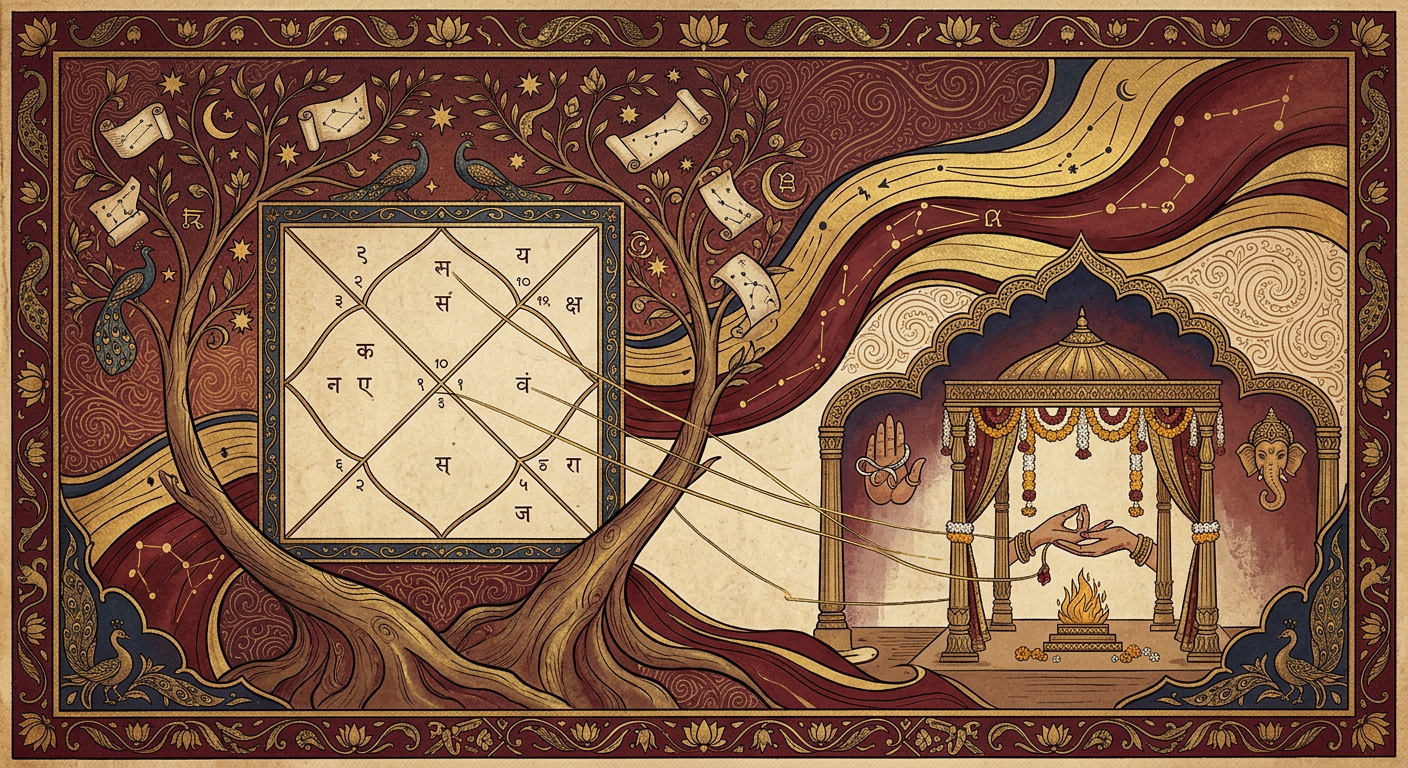
In my practice at Daivagya in Noida, one of the most frequent and emotionally heavy concerns brought to my table is the unexpected postponement of marriage. When an educated, accomplished, and well-meaning individual experiences proposal after proposal falling through at the eleventh hour, family anxiety naturally builds. People often begin to wonder if some severe curse or incurable flaw exists in their horoscope.
Vedic astrology views time not as an arbitrary countdown, but as a maturing of specific karmic threads. When we examine delayed marriage in astrology, our primary objective is never to instill fear or promise overnight miracles. Instead, it is to understand the astrological mechanics creating the pause, recognize when those energies mature, and prepare the individual to act decisively when the planetary weather turns favorable.
Recently, I reviewed the journey of a chart where marriage had been delayed well into the mid-thirties despite active, sincere searching. By looking closely at how the birth chart, divisional charts, planetary periods, and transits intersected, we can clearly see why the roadblock existed and how the resolution finally took place.
Why does marriage get postponed despite continuous efforts?
In many charts where marriage is delayed, the delay is rarely caused by a single isolated factor. More often, it is a confluence of planetary maturity periods, dasha sequences, and the disposition of relationship karakas (significators) like Venus and Jupiter.
When parents or individuals come to me after years of fruitless matchmaking, they often ask why things stall precisely when negotiations seem complete. The answer lies in the subtle layers of the horoscope. A strong seventh house may promise a loving spouse, but if the current operating planetary period (Mahadasha or Antardasha) is ruled by planets connected to the sixth, eighth, or twelfth houses, the environment simply refuses to support a final commitment.
Astrology teaches us that delay is fundamentally different from denial. Denial is indicated when the primary and secondary houses of union suffer severe, unmitigated afflictions across both the birth chart (Rasi) and the harmonic marriage chart (Navamsa). Delay, on the other hand, is simply Saturn's steady hand or Rahu's wandering nature asking for maturity, emotional readiness, or the resolution of specific karmic dues before two lives merge.
What planetary combinations caused the initial delay?
In the chart under study, the native possessed a well-placed ascendant with strong professional indicators, yet several classical astrological reasons for marriage delay were visibly working together in the primary Rasi chart (D1):
- Saturn’s aspect on the 7th house and its lord: Saturn is the great taskmaster of the zodiac. When Saturn casts its third, seventh, or tenth aspect onto the seventh house or the seventh lord, it enforces patience, slows down developments, and demands complete emotional maturity before granting marital stability.
- Rahu’s presence in the 2nd house of family: The second house governs family expansion and domestic harmony. Rahu placed here can create frequent misunderstandings during family-level discussions, unrealistic expectations, or sudden reversals just before an agreement is finalized.
- Combustion of the 7th house lord: In this specific horoscope, the ruler of the seventh house was placed within five degrees of the Sun. While this does not destroy marital prospects, it creates an atmosphere where ego friction, rigid preferences, and misaligned priorities can scuttle early matches.
- Operating Mahadasha of an obstructive planet: During the peak matrimonial search years (ages 27 to 32), the native ran the sub-period of a planet situated in the eighth house. The eighth house brings unpredictability, sudden pauses, and emotional fatigue, making sustained romantic progress difficult.
To understand your own foundational planetary layout, you can generate your chart using our free kundli tool and examine which planets currently occupy or aspect your seventh and second houses.
How did the Navamsa (D9) chart alter the assessment?
One of the most critical rules in Jyotish is that the birth chart (D1) represents the tree, but the Navamsa (D9) represents the fruit. Never make a definitive judgment on marriage solely from the Rasi chart.
In this native's Rasi chart, the seventh house appeared troubled and stressed. However, when I opened the Navamsa chart, the narrative changed dramatically. The planetary strength within the D9 revealed why this was a case of delayed fulfillment rather than permanent obstruction:
- Vargottama Lagna: The ascendant in both the Rasi and Navamsa charts fell in the same sign. A Vargottama ascendant provides deep psychological resilience and ensures that the core promises of the chart eventually manifest.
- Exalted Jupiter in the 9th house of the D9: Jupiter occupied its sign of exaltation in the house of fortune in the Navamsa. This placement acted as a protective shield, indicating that divine grace and righteous partnership were destined to emerge once the obstructive dasha concluded.
- Venus in a friendly trine: While Venus suffered minor afflictions in the primary chart, it was clean, strong, and aspected by natural benefics in the Navamsa. This confirmed that the capacity for mutual affection and lasting devotion remained unblemished.
When the Navamsa chart is inherently strong while the Rasi chart displays friction, the native experiences significant delays and tests during youth, but settles into a remarkably grounded, supportive marriage later in life.
Which Mahadasha and Antardasha unlocked the marriage window?
The timing of any major life milestone depends entirely on the directional flow of the Vimshottari Dasha. A person may meet dozens of eligible prospects, but the sacred ceremony will not materialize until a planet capable of activating the seventh, eleventh, or second house takes command of the chart.
In this case, the resolution began when the native concluded an eight-year cycle influenced by the sixth and eighth houses and transitioned into the Mahadasha of Jupiter, followed by the Antardasha of the seventh lord. Jupiter, holding lordship over an auspicious trine and aspecting the Lagna, immediately shifted the native's mindset from anxiety and overthinking to calm readiness.
The sub-period (Antardasha) planet was explicitly connected to the seventh house in the birth chart and occupied an angular house in the Navamsa. The moment this dasha exchange commenced, communication with potential partners became smoother, parents found aligned families, and unnecessary hesitations melted away.
Understanding the timing of marriage in Vedic astrology is less about guessing specific dates and more about recognizing these planetary shifts so that families focus their matchmaking energy during supportive windows rather than exhausting themselves during adverse cycles.
How did the double transit of Saturn and Jupiter activate the 7th house?
Dasha provides the internal readiness and environmental opportunity, but transit (Gochara) provides the final physical trigger. In classical Vedic astrology, no marriage takes place without the sanction of the two heavyweight planets: Saturn and Jupiter.
According to the foundational double-transit principle:
- Jupiter must bless the seventh house, the seventh lord, the Lagna, or the Lagna lord by conjunction or aspect.
- Saturn must approve the same key houses or lords through its slow, structural transit.
During the year the native finally wed, transiting Jupiter entered a sign from where it cast its auspicious fifth aspect directly onto the seventh house and the natal Venus. Simultaneously, transiting Saturn moved into a position where its tenth aspect touched the ascendant lord.
When both great planets simultaneously cast their gaze upon the axis of partnership, the karmic locks opened. A proposal that arrived during this double-transit window moved seamlessly from initial conversation to engagement within four months, without the confusion that had plagued previous attempts.
What role did the Upapada Lagna play in identifying the turning point?
In Jaimini astrology, the Upapada Lagna (UL)—calculated from the position of the twelfth house lord—provides extraordinary precision regarding marriage, the nature of the spouse, and the exact circumstances under which family alliances solidify.
In this native's chart, the Upapada Lagna was seated in an earth sign, ruled by Mercury, with a strong aspect from a benefic Moon. This revealed three crucial details that had been overlooked during earlier matchmaking attempts:
- The life partner would arrive through professional or intellectual networks rather than traditional informal family inquiries.
- The spouse would be practical, analytical, grounded, and emotionally balanced.
- The marriage would only formalize when transiting Jupiter cast an aspect on the sign of the Upapada Lagna itself.
Once we mapped the transit of Jupiter over the Upapada Lagna, the timeline aligned perfectly with the dasha shift. This Jaimini confirmation gave the native clear mental peace, allowing them to stop panicking over failed meetings and prepare purposefully for the upcoming supportive window.
How planetary influences shape delays versus timing resolutions
To help you visualize how contradictory forces operate within a birth chart, the table below illustrates the contrasting planetary dynamics observed in this chart:
| Astrological Factor | Delay / Friction Mechanism (Earlier Phase) | Resolution / Marriage Trigger (Activation Phase) |
|---|---|---|
| 7th House & Lord | Aspect of Saturn created rigid standards and recurring procedural delays. | Dasha of the 7th lord began, clearing past karmic blockages. |
| Operating Dasha | Sub-period connected to the 8th house brought sudden cancellations. | Jupiter Mahadasha began, activating the 9th house of fortune. |
| Transits (Gochara) | Saturn placed unfavorably relative to the Moon sign; Jupiter unsupportive. | Dual transit of Saturn and Jupiter simultaneously blessed the 7th axis. |
| Navamsa (D9) | Native was operating under unrefined youthful expectations. | Exalted Jupiter in D9 matured, providing stability and mutual respect. |
| Upapada Lagna | Matchmaking pursued through mismatched channels not indicated by UL. | Jupiter transited the sign aspecting the Upapada Lagna, finalizing the alliance. |
Which practical and Vedic remedies helped remove the subtle obstacles?
When dealing with marriage delay remedies, I always guide clients away from superstitious fear and toward practical, sattvic measures that balance planetary energies naturally. Remedies do not rewrite your destiny; they remove the spiritual and psychological friction that prevents your positive karma from manifesting smoothly.
For this native, whose delay was driven by an afflicted seventh lord and a heavily placed Saturn, we implemented a straightforward, disciplined routine:
- Strengthening the benefic significator: Because Jupiter was well-placed in the Navamsa, the native was advised to observe simple dietary discipline on Thursdays and offer water to the roots of a peepal or banana tree without fail.
- Pacifying Saturn's harsh edge: To soften the restrictive third aspect of Saturn on the seventh house, the native engaged in regular Saturday charity, offering mustard oil, black sesame seeds, and warm meals to elderly, underprivileged individuals.
- Mantra Japa for emotional clarity: Chanting the Swayamvara Parvathi Mantra or the Brihaspati Gayatri daily helped quiet the mental agitation caused by repeated rejections, restoring self-worth and confidence.
- Behavioral and mindset alignment: Astrology is incomplete without conscious human effort. The native was encouraged to consciously re-evaluate rigid checklists regarding minor superficial traits, focusing instead on shared values, character, and emotional maturity.
Within nine months of consistent remedy practice, planetary shift, and conscious search realignment, the native finalized their alliance with complete mutual joy from both families.
What steps should you take if your own marriage search is stalling?
If you find yourself or your child facing repetitive hurdles in finding a life partner, it is vital not to sink into despair or jump to extreme conclusions. A delayed marriage is simply an invitation to understand your astrological timeline better.
Take a structured approach to your situation:
- Verify your exact birth data: Ensure your birth time is accurate to the minute, as a few minutes can alter the Navamsa Lagna and the sub-period timings significantly.
- Look beyond surface-level Guna scores: High Guna matching means little if the individual dashas of the couple are fundamentally hostile to stability.
- Identify the maturing age of your delay-causing planets: Saturn matures at age 36, Rahu around 42, and Jupiter at 16 or 32. Often, marriage materializes naturally right around a planet's natural maturation.
- Align your actions with favorable transits: Focus your matchmaking efforts vigorously during months when Jupiter aspects your natal Moon, Venus, or seventh house.
When you are ready to examine your chart with depth, objectivity, and genuine care, you can book a consultation with me at Daivagya. Together, we will analyze your D1, D9, dasha sequences, and practical remedies to bring clarity and direction to your marriage journey.
Frequently asked questions
Can a severely delayed marriage still result in a happy married life?
Yes, absolutely. In Vedic astrology, delay often functions as a protective mechanism. When Saturn or a slow-moving planetary period delays marriage, it burns through immature desires and karmic friction early. Charts that experience late marriages frequently enjoy deep stability, mutual maturity, and enduring companionship because both partners enter the alliance with realistic expectations and emotional balance.
Does Manglik Dosha always cause marriage delay?
No. Manglik Dosha (Mars placed in the 1st, 2nd, 4th, 7th, 8th, or 12th house) primarily influences temperament, energy dynamics, and assertiveness in relationships, not delay by default. Delay occurs primarily when Mars combines with Saturn, the Sun, or Rahu, or when the seventh lord itself is situated in difficult houses without benefic support.
How does the Navamsa chart reveal if marriage is promised?
While the birth chart indicates your external social environment, the Navamsa chart (D9) reveals your inner capacity for partnership and long-term destiny. If the seventh house, its lord, or Venus/Jupiter are strong and well-aspected in the Navamsa—even if afflicted in the Rasi chart—marriage is firmly promised once the challenging dasha cycle passes.
How long do planetary remedies take to show results for marriage delays?
Remedies operate on subtle psychological and karmic levels rather than functioning like immediate switches. Typically, consistent practice of sattvic remedies (such as mantra japa, specific charity, and planetary discipline) over a cycle of 40 to 120 days helps calm mental resistance, soften planetary afflictions, and prepare you for favorable upcoming transits.
Is it wise to reject a proposal solely because a single dosha is present?
No, rejecting a sound proposal over an isolated dosha without holistic chart analysis is a common mistake. Most classical doshas—including Nadi, Bhakoot, or Manglik dosha—have recognized cancellation rules (Parihara) based on planetary friendship, sign lord placement, and Navamsa strength. Always consult an experienced astrologer to evaluate overall chart compatibility before making a decision.
Continue reading
When Will I Get Married? A Complete Guide to Predicting Marriage Age From Your Birth Chart
Learn how Vedic astrology reveals your marriage age through the 7th house, Vimshottari Dasha, Navamsa, and planetary transits in your birth chart.
When a Man's Career Delays His Marriage
Explore why demanding professional goals postpone marriage for men and how Vedic astrology reveals the right window to balance ambition and partnership.
Marriage in a Man's Chart: What Venus Signifies
Discover how Venus acts as the key significator of marriage in a man's horoscope, revealing spouse qualities, mutual harmony, and marital happiness.
Marriage Prospects in a Woman's Chart: What Jupiter Signifies
Discover what Jupiter signifies in a woman's birth chart, from the nature of the husband to marriage timing, Navamsa strength, and Vedic remedies.
Want your specific situation analysed?
Book a private Marriage & Relationship Consultation with Dr. Rahul Singh — your charts read in detail, with a clear, confidential opinion you can act on.
Limited offer · was ₹7,500 · 60-minute consultation + detailed written analysis